Origins: Fair Skinned Girl and Dark Skinned Guy Make the Best Pair
🎬 Gendered Colorism in South Indian Cinema

Meanwhile, Vijay Sethupathi, who shares the same skin tone and body type, faces no such scrutiny.
This contrast exposes a deeper truth:
- Colorism in South Asia is deeply gendered.
- Dark skin is generally unfavored in Indian communities worldwide.
- But dark-skinned women are far more penalized than dark-skinned men.
I have three young dark skinned nephews. Their grandmother tells them, "Study, get a good job and earn well. Then you can get beautiful, fair-skinned wives."
👶🏾 How Colorist Values Are Passed Down
I have three young nephews with dark skin.
Their grandmother tells them:
“Study well, get a good job, earn well. Then you can get beautiful, fair-skinned wives.”
So where does this mindset come from?
🎥 Tamil cinema.
🧠 Brahminical–Dravidian Juxtaposed Gender-Based Colorism
I call this phenomenon:
Brahminical–Dravidian Juxtaposed Gender-Based Colorism
Here’s how it operates:
👩🏽 Expectations from Women
Women are expected to possess Indo-Aryan features, such as:
- Fair skin
- An adolescent, youthful appearance
- “White” armpits and genitalia
- A slim, delicate body
👨🏾 Expectations from Men
Men, however, are allowed—and celebrated—for having:
- Dominant Dravidian features
- Dark skin
- Rugged, “earthy” masculinity
 |
| A meme from Reddit |
When a woman with Dravidian features is cast as a tribal woman,
- Dravidian men conveniently shift their gaze toward Indo-Aryan-looking women.

- In Jigarthanda Double X, he even aspires to become the first dark-skinned hero in Indian cinema.
🎥 Representation That Isn’t Welcome
Finally, we have an actress like Nimisha Sajayan. She represents the average South Indian Dravidian woman—the girl next door.

Yet, this realism is not well received by South Indian Dravidian men.
At a press conference, a journalist told Karthik Subbaraj that:
- Nimisha may not be “beautiful,” but she acts well.
- Karthik gave a befitting reply, calling out the bias.
Interestingly:

- No one objected when Raghava Lawrence built the Muni Cinematic Universe using:
- Only the fairest, often imported actresses
- Vedhika, Tapsee, Lakshmi Rai, Nithya Menen

- A British woman was imported
- Brown contact lenses were placed over her blue eyes
- And she was passed off as Indian or Anglo-Indian
But when South Indian female realism arrives in the form of Nimisha Sajayan,
🗣️ disparaging remarks suddenly pour in about her Dravidian features.
🎞️ Decoding Colorism Against Women in Sivaji the Boss
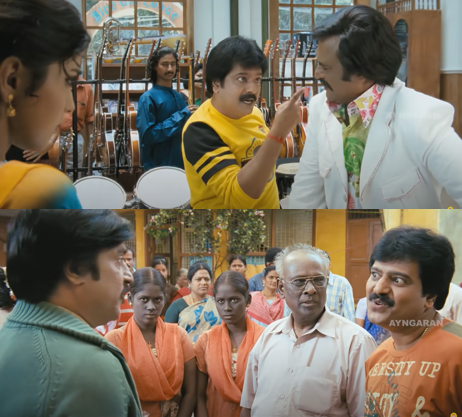
In Sivaji:

- Shriya mocks Rajinikanth’s dark skin by saying it doesn’t “match” hers.
- Vivek launches into an emotional monologue celebrating the pride of dark skin.
- "Dravidians' true color is dark brown."
Yet:

- Vivek makes fun of Anggavai and Sanggavai's skin tone.
- Rajini makes a disgusted countenance: a pout and a disapproving grunt.
- And reject two women with the same skin tone as Rajini.
Do you see the gender dynamics?

- Dark skin on men is generally acceptable - but not on women.
- Fair skinned women paired with dark skinned men is acceptable.
- Fair skinned men paired with dark skinned women is weird, abnormal even.
For added effect:

-
Director Shankar literally pours bitumen on the twin girls.
Those who insist that Rajini didn't say anything to insult the blackened girls:

- Revisit the scene and look closely at Rajini's reaction to Vivek's "Okay for you?"
- Insult isn't always verbal.
- One can insult through body language.
Magnetic eyes, check. Swagger style, check. Skin color, hypocrisy.

- Solomon Paapayah stacks up the characteristics that make Rajinikanth attractive.
- But his skin color?
- His skin tone is the same as the girls he just rejected with a pout.
Conclusion: Dark skin on men, usually desirable. Dark skin on women, usually derision.
Dark-skinned women for comedy relief.

- Anggavai and Sanggavai's original skin tone is fairer than Rajini's.
- Why can't he reject the girls as they are: fair skinned?
- What's so funny about rejecting dark skinned women?
Parents who fail to stand up for their children who are body shamed.
- Solomon Paapayah gets antsy when Vivek fails to understand a "beautiful Tamil name."
- But when Vivek insults both girls of being "burnt" (romba ponga vechitinga polarku)...
- As a father, he stands like a statue, not defending his children.
Casteism in colorism

- I don't think it's brilliant.
- It's soaked in Brahminism: fair means "upper caste", dark means "lower caste."
- Worse, somehow, fair skin is strongly emphasized on women in our society.
- Men aren't judged as strongly for being chocolate.
Final words...

- Dark skin is somewhat ok when it's on men.
- Men can compensate by being rich and well-educated.

- Women receive the short end of the stick:
- A woman may be well-educated and hold an important position.
- She'll still be judged by her looks.
- If she's Indian/South Asian - her skin color.
- This needs to change!
Rajinikanth broke the norm of fair-skinned hero despite starting out as a villain and gave confidence to millions of South Indian men with Dravidian features. He was paired with the fairest women on screen and this birthed the idea, "Dark boy and white girl make the best pair."

🌟 Rajinikanth and the Birth of a Problematic Ideal
Rajinikanth broke the norm of the fair-skinned hero.
-
He gave confidence to millions of South Indian men with Dravidian features.
-
His rise was revolutionary—and deserved.
But there was a consequence.
-
He was almost always paired with the fairest women on screen.
-
This birthed the belief:
“Dark boy and white girl make the best pair.”


Comments
Post a Comment